
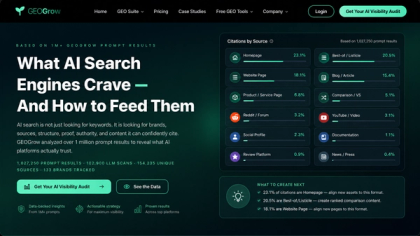
What AI Search Engines Crave and How to Feed Them
AI search is not just looking for keywords. It is looking for brands, sources, structure, proof, authority, and content it can confidently cite. GEOGrow analyzed over 1 million prompt results to reveal what AI platforms actually trust.
1,027,250 prompt results · 102,900 LLM scans · 154,235 unique sources · 133 brands tracked
Every brand will have a different mix of content the LLMs prefer
High-Level Takeaways
Daily Citation Data
We've gathered 1 Million prompt results and growing to figure out what the Chatbots like to eat.
From SEO to GEO: The New Rules of Visibility
For years, digital marketing was built around one primary question:
How do we rank higher on Google?
That question still matters.
But it is no longer enough.
Buyers are now asking ChatGPT, Gemini, Claude, Perplexity, and Google AI Overviews for recommendations, comparisons, summaries, and buying guidance. They are not just searching for links. They are asking AI systems to make sense of the market for them.
That changes everything.
SEO was about optimizing your website for search.
GEO is about optimizing your brand for AI understanding, trust, and recommendation.
It is not just your homepage.
It is not just your blog.
It is not just your keywords.
It is not just your backlinks.
It is the full picture of how your brand is represented across the internet — your website, content architecture, reviews, third-party mentions, product pages, comparison pages, source citations, entity data, and the language people use when talking about you.
AI search engines crave clear, structured, trustworthy information.
The brands that feed them best will be the brands they recommend most.
What Do AI Search Engines Actually Cite?
GEOGrow analyzed platform-wide prompt tracking data across major AI search engines, including ChatGPT, Claude, Gemini, Google AI, and Perplexity.
The data includes:
1,027,250 prompt results
102,900 LLM scans
154,235 unique sources
133 brands tracked
869,662 web citation events
This gives us a real-world view of what AI platforms are actually pulling from when they answer buyer questions.
And the pattern is clear:
AI platforms do not rely on one type of content.
They cite a mix of brand-owned, third-party, social, editorial, review, and comparison-based sources.
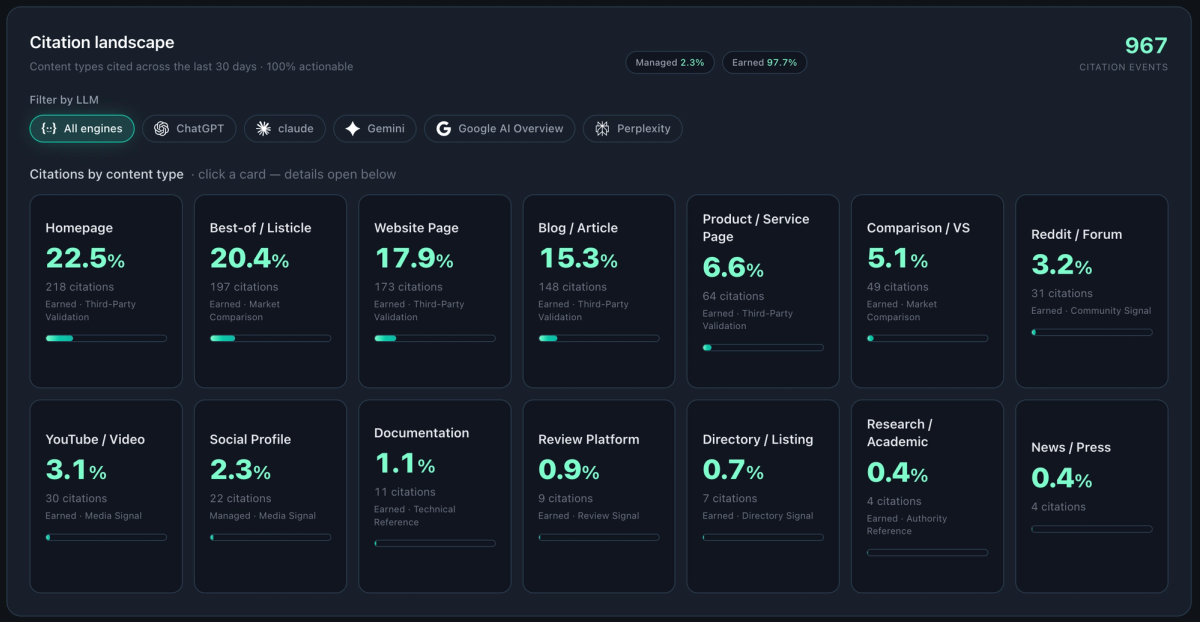
Your Brand Has Its Own AI Search Fingerprint
Every brand has a different citation profile.
Platform-wide data tells us what AI search engines tend to trust.
But GEOGrow goes deeper.
We can break this same intelligence down brand by brand, showing exactly which content sources AI platforms are using when they answer prompts related to your company, competitors, products, services, and category.
That means we are not guessing what your brand needs.
We can see:
Which sources AI platforms cite when your brand appears
Which sources they cite when competitors appear instead
Which content types are helping you win
Which content types are missing from your footprint
Which platforms prefer which sources
Where your website is strong
Where third-party validation is weak
Where comparison, review, Reddit, or video content may be influencing the answer
This gives every brand a practical roadmap for GEO.
Every LLM Has Different Content Preferences
Not every AI platform behaves the same way.
ChatGPT, Gemini, Claude, Perplexity, and Google AI may all answer similar prompts, but they do not always cite the same types of sources.
One platform may lean more heavily on homepages and core website pages.
Another may favor listicles, comparison pages, or review platforms.
Another may surface Reddit, forums, YouTube, or documentation more often.
GEOGrow shows these differences clearly.
So instead of creating generic “AI content,” we can identify what each platform is actually consuming for your brand and your market.
Content Types LLMs Cite Most
Based on GEOGrow’s platform rollup:
Homepage
35.6% of citations
309,589 citations
AI platforms frequently cite a brand’s root domain. This makes the homepage more important than ever. It needs to clearly explain who you are, what you do, who you serve, why you are different, and what proof supports your claims.
Website Pages
34% of citations
295,407 citations
General website pages are heavily cited. These include service pages, product pages, location pages, industry pages, and other core content. This is where brand architecture matters.
Best-of / Listicle Content
14.4% of citations
125,620 citations
AI engines often pull from pages that compare, rank, or summarize options. These pages help AI answer “best,” “top,” and “recommended” prompts.
Blog / Article Content
7.7% of citations
67,166 citations
Blogs still matter, but they are not the entire strategy. Blog content works best when it supports clear buyer intent, reinforces brand authority, and connects to core service or product architecture.
Social Profiles
2% of citations
17,545 citations
Social profiles can help reinforce brand identity, legitimacy, and activity.
Review Platforms
1.6% of citations
14,020 citations
Reviews help AI systems understand trust, reputation, customer experience, and market validation.
News / Press
1.3% of citations
11,712 citations
Press and news mentions provide authority signals, especially when they support claims about innovation, leadership, growth, or credibility.
Comparison / VS Pages
1.3% of citations
10,982 citations
Comparison pages help AI answer competitive questions. If you do not define how you compare, AI may rely on your competitors or third-party sources to do it for you.
YouTube / Video
0.9% of citations
7,544 citations
Video can support credibility, education, and brand presence, especially when it is well-titled, well-described, and connected to the right topics.
Reddit / Forum
0.8% of citations
6,841 citations
Community conversations matter because they reveal real buyer language, objections, experiences, and trust signals.
Documentation
0.1% of citations
996 citations
For technical, SaaS, industrial, and B2B brands, documentation can be a powerful trust layer when AI needs precise product or service information.
Wikipedia / Knowledge Base
0.1% of citations
788 citations
Knowledge-base sources matter for entity understanding, especially when AI is trying to verify what a brand, product, person, or organization is.
AI Search Has Changed the Buyer Journey
People used to search, scan results, click websites, and compare options themselves.
Now they ask AI.
They ask questions like:
Who is the best provider near me?
What company should I trust for this service?
Which product is best for my situation?
How does this brand compare to its competitors?
What are the top companies in this category?
What do customers say about them?
That means AI platforms are increasingly becoming the first layer of brand discovery.
If your brand is not included in the answer, you may never make the shortlist.
AI Does Not Just Read Your Website. It Reads Your Footprint.
AI search engines look across the internet to understand your brand.
They evaluate signals like:
- Your homepage
- Your service and product pages
- Your location pages
- Your FAQs
- Your blog content
- Your reviews
- Your social profiles
- Your third-party mentions
- Your comparison presence
- Your Reddit and forum mentions
- Your YouTube content
- Your structured data
- Your consistency across sources
- Your authority in relation to competitors
This is why GEO is not just a content project.
It is a brand visibility system.
What AI Search Bots Crave
AI engines are trying to answer confidently. To do that, they need content that is easy to understand, verify, compare, and cite.
They crave:
Clear Brand DNA
AI needs to understand what makes you different. If your positioning is vague, generic, or inconsistent, AI has very little to work with.
Your brand should clearly answer:
Who are you?
What do you do?
Who do you serve?
What makes you different?
Why should someone trust you?
What proof supports your claims?
Clean Site Architecture
AI needs a clear map of your expertise.
That means your website should have structured pages for your services, products, audiences, industries, locations, use cases, and FAQs.
A thin website with vague pages gives AI very little to cite.
A well-structured website gives AI a strong foundation.
Direct Answers to Real Prompts
AI search is prompt-driven.
That means content should be built around the actual questions buyers ask, not just old-school keyword lists.
Examples:
- “What is the best [service] near me?”
- “Who are the top [category] companies?”
- “Is [brand] better than [competitor]?”
- “What should I look for when choosing a [provider/product]?”
- “What are the pros and cons of [solution]?”
- “How much does [service/product] cost?”
- “What companies offer [specific feature]?”
The closer your content matches real buyer prompts, the easier it is for AI to use.
Proof and Trust Signals
AI platforms are cautious. They need evidence.
Strong GEO content includes:
- Reviews
- Testimonials
- Case studies
- Awards
- Certifications
- Before-and-after examples
- Customer outcomes
- Industry mentions
- Third-party citations
- Press coverage
- Comparison proof
- Specific claims backed by details
Generic marketing language is weak.
Specific proof is strong.
How to Feed AI Search Engines
This is where GEOGrow comes in.
GEOGrow helps brands move from guessing to knowing.
Instead of assuming what AI platforms care about, GEOGrow tracks prompts, scans answers, identifies competitors, analyzes citations, detects content gaps, and shows where your brand is winning or losing in AI search.
The process starts with your Brand DNA.
Then we build the architecture around it.
Then we create content that feeds AI systems.
Then we measure whether it works.
Then we improve.


